How pinless moisture meters work, and how to read moisture meter readings
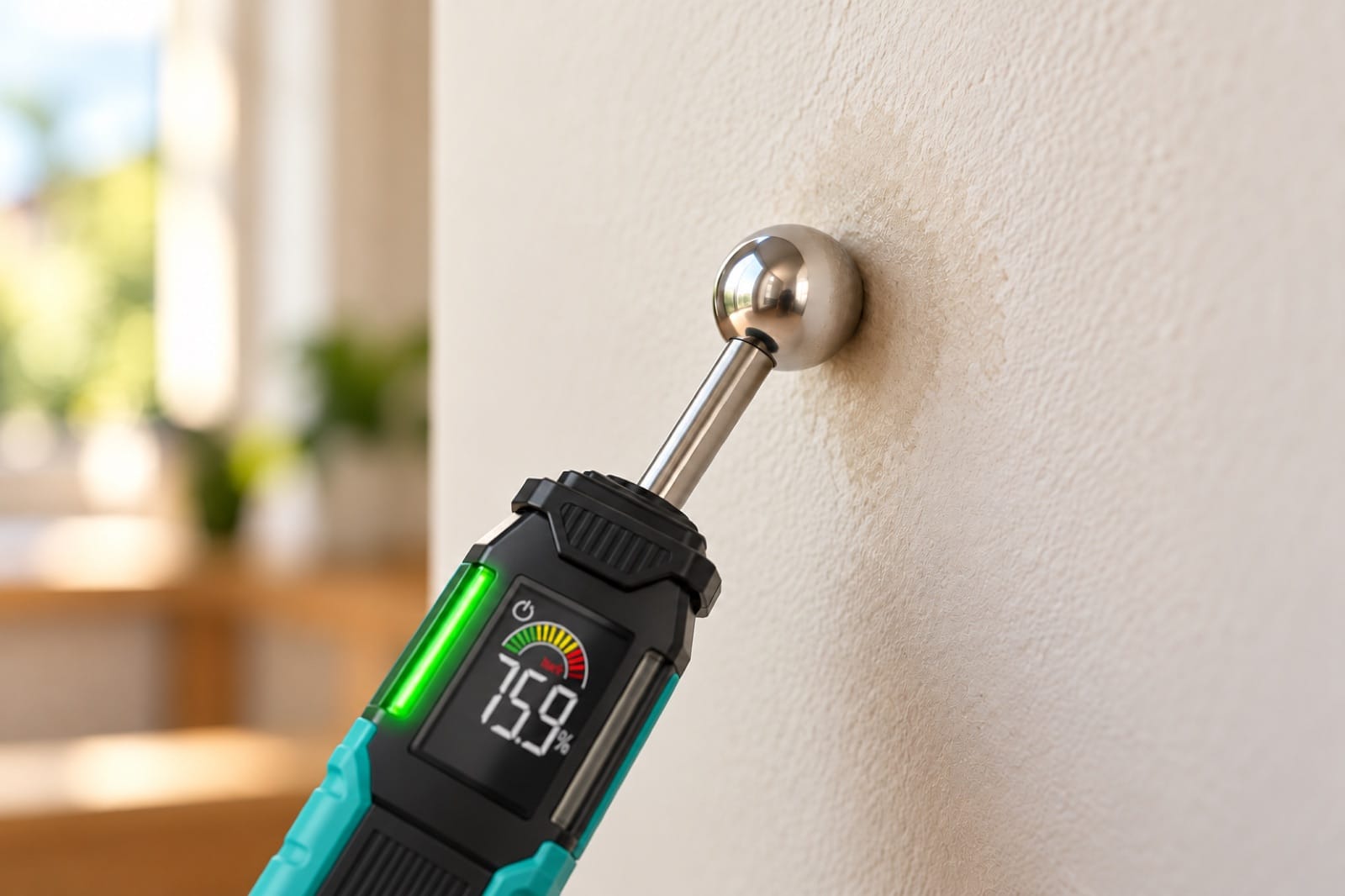
Press a pinless moisture meter against a wall and a number appears in a second, with no holes and no waiting. It looks like magic, but moisture meter readings are easy to get wrong: the same meter can show a low number on one wall and a much higher one on another when both are perfectly dry.
Here's what the meter actually measures, how deep it sees, what throws it off, what counts as a normal reading, and a simple way to get numbers you can trust.
Short answer: Moisture meter readings only mean something on the right scale and next to a dry reference. A pinless meter senses water through a weak electric field, so metal, density and contact all move the number. Compare with a known-dry spot on the same material: a broad, climbing area suggests moisture; one sharp spike usually means metal.
What is the difference between a pin and a pinless moisture meter?
There are two common kinds of handheld moisture meter, and they work in completely different ways.
Pin meters push two metal pins into the material and pass a small current between them. Dry wood or drywall resists electricity strongly; wet material conducts much better. The meter turns that resistance into a reading.
Pinless meters don't break the surface. They measure how the material responds to a weak electric field, and that response changes sharply when water is present.
| Pin meter | Pinless meter | |
|---|---|---|
| How it measures | Electrical resistance between two pins | Capacitance or impedance through a sensor pad or ball |
| Marks the surface | Yes, two small holes each time | No |
| What it reads | The material between the pin tips, at the depth you push them | A volume under the sensor, strongest near the surface |
| Speed over a large area | Slow: one hole per reading | Fast: slide or tap across a wall |
| Best at | An exact reading at one spot and depth | Mapping where it's wet and how far it spreads |
| Fooled by | Salts and some chemical treatments in the material | Metal, density changes and poor contact |
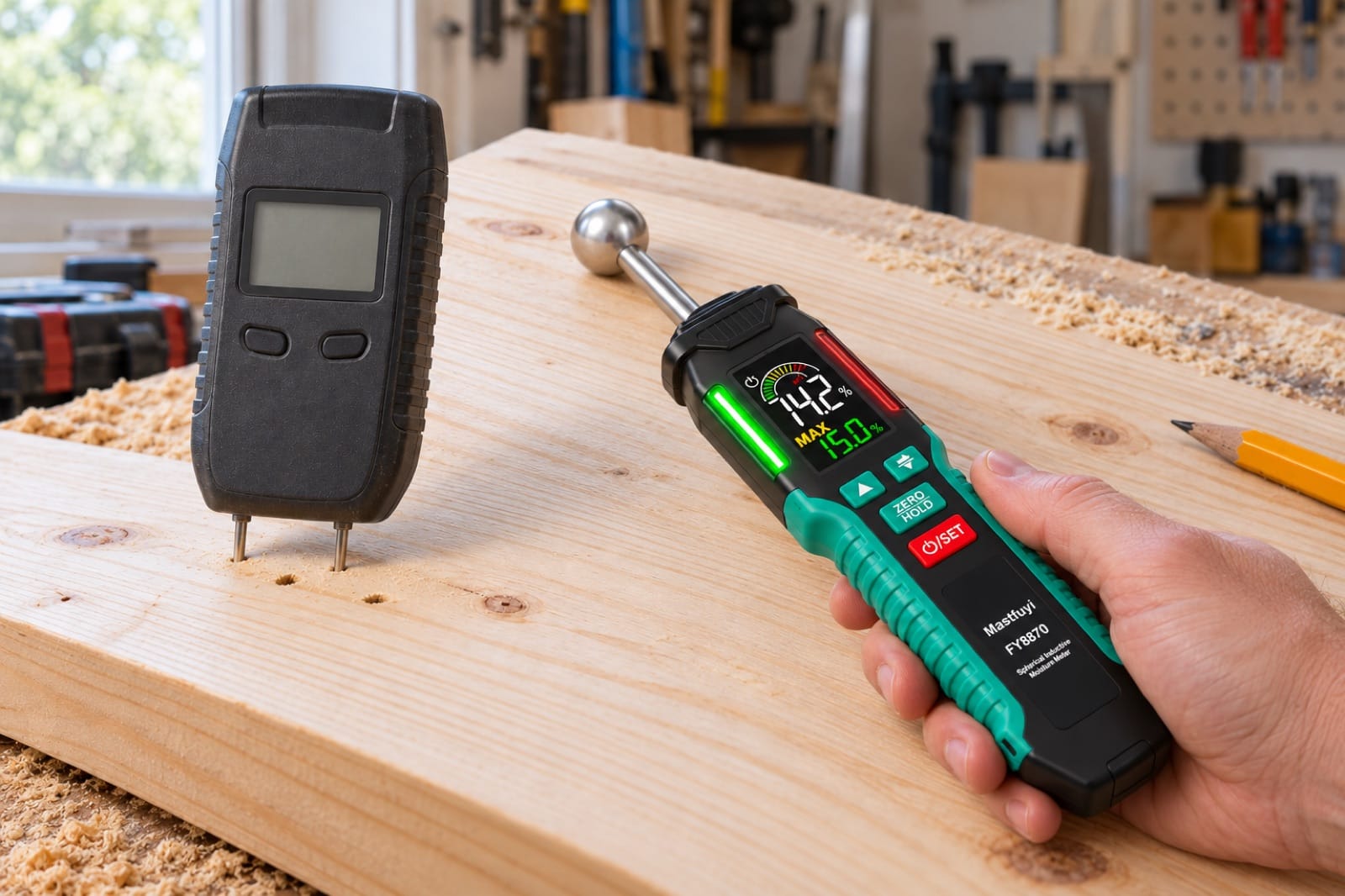
Illustration: a pin meter reads between its pin tips and leaves two holes; a pinless meter reads the material under its sensor without marking it.
How does a pinless moisture meter work?
Inside the sensor are electrodes that set up an alternating electric field. The field reaches out of the sensor into whatever it's pressed against, and the meter measures how much that material changes the field.
The key property is the dielectric constant: how strongly a material responds to an electric field. Water's is around 80. Most dry building materials, such as wood, gypsum and cement, sit in the single digits. So even a small amount of water in drywall raises its overall response far more than you'd expect from the amount of water alone.
Some meters measure the change in capacitance (the material acts as part of a capacitor with the electrodes). Others measure impedance, which also takes in how well the material conducts. In both cases, more water means a bigger change, and the meter shows a bigger number.
How deep does a pinless meter read?
The field is strongest right at the sensor and fades with distance. That has two consequences.
- Depth has a range, not a single value. A typical pinless meter reads somewhere between a fraction of an inch and an inch or two deep, depending on the material and the design. It doesn't see a whole thick wall.
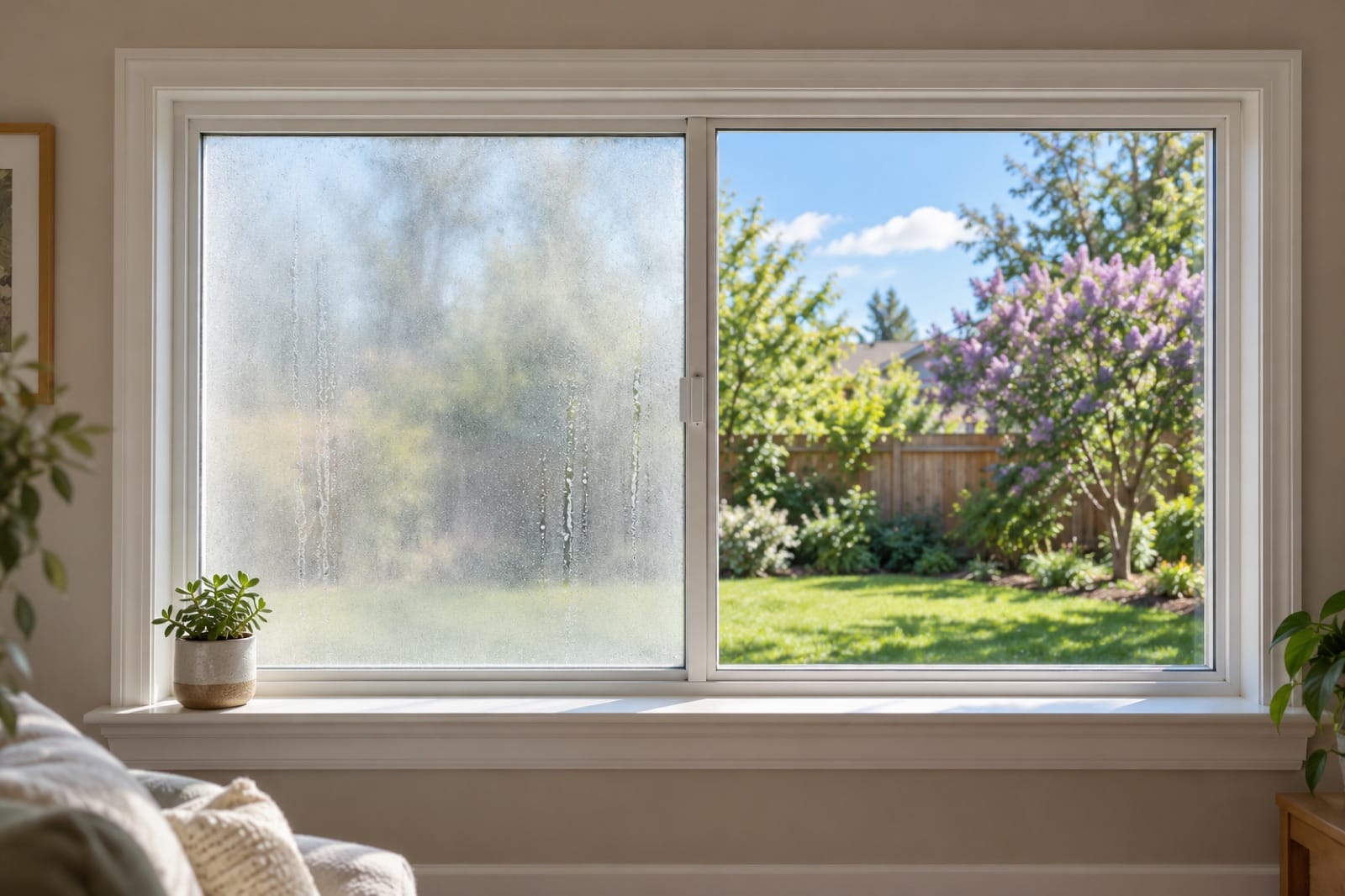
- The surface counts most. A wet layer just under the paint moves the reading more than the same water deeper down. Condensation on the surface, or a wall that was just wiped, can push the reading up for a while.
So a pinless meter answers "is there moisture in the outer layer of this material, and how much more than nearby?". It doesn't tell you what's happening on the far side of a thick wall.
Why are moisture meter readings relative?
The biggest misunderstanding: on most pinless meters, the number isn't a precise percentage of water in the material. It's a reading on the meter's own scale, calibrated against a reference material.
That's because the field responds to more than water:
- Density. Denser material responds more strongly. Hardwood reads higher than softwood at the same moisture, and cement reads higher than drywall even when both are dry.
- Metal. Metal changes the field dramatically. Nails, screws, corner beads, pipes, metal lath behind old plaster and foil-backed insulation can all cause a sudden jump.
- Contact. An air gap weakens the field. A rough surface, a tilted sensor or a textured finish reads lower than flat, firm contact.
- Layers. Tile over a backer board, paint over drywall, or a laminate floor over a subfloor all mix into one reading.
Material modes on a meter help, because they adjust the scale for the typical density of wood, gypsum or cement. They can't know the exact board, mix or wall build in front of you.
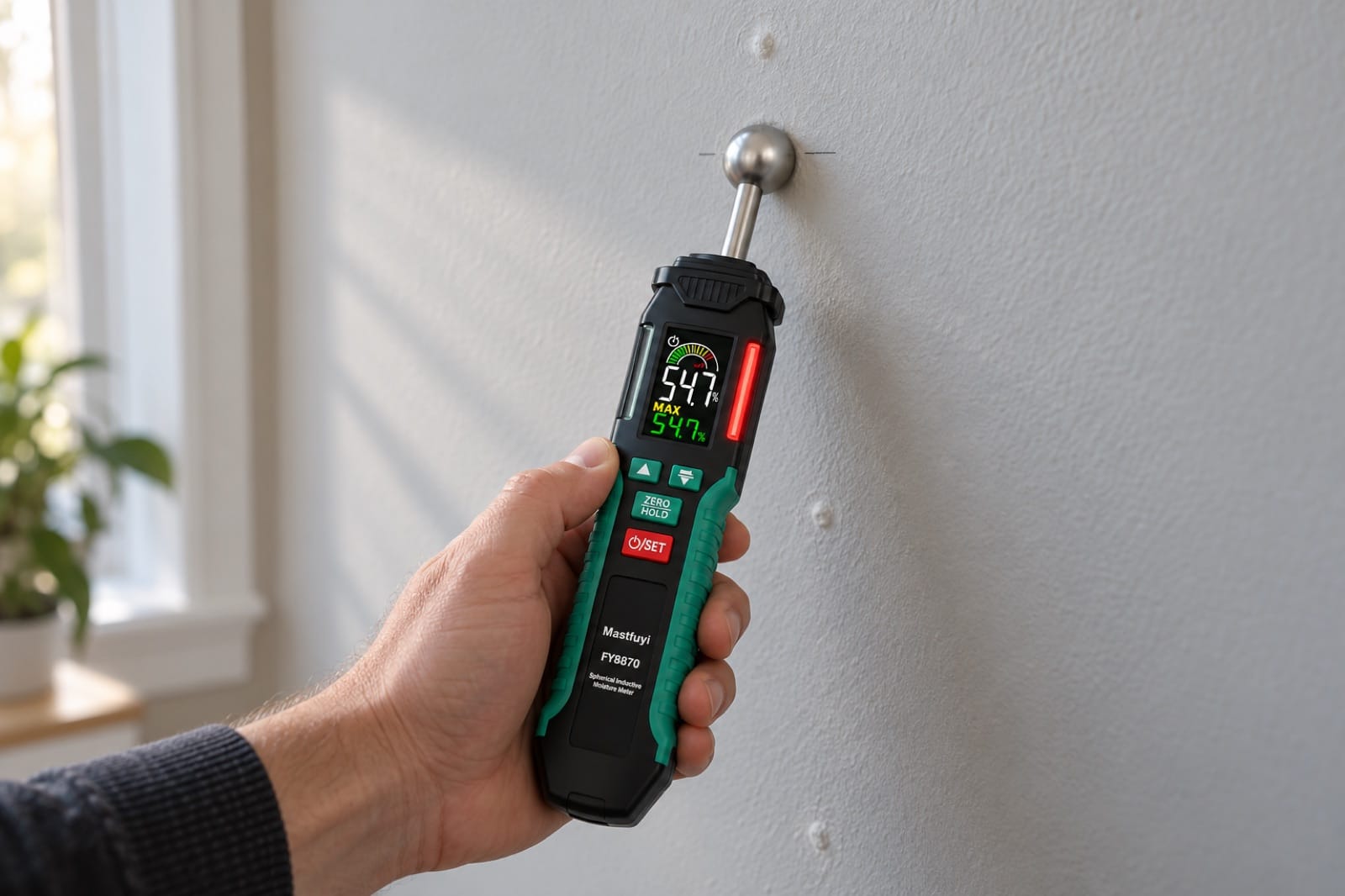
Illustration: a single sharp peak over a screw or a pipe is metal, not water; move a few centimeters aside and compare.
What is a normal moisture reading for a house?
There's no single normal number, because every reading depends on the material and your meter's scale. This chart shows common rules of thumb, not a standard, and your meter's manual comes first.
| What you're reading | Usually dry | Worth watching | Treat as wet |
|---|---|---|---|
| Wood, on a scale showing % moisture content | Under about 15% | About 15–20% | Over about 20% |
| Drywall, on a gypsum scale showing true % moisture | Under about 1% | Just above 1% | Well above 1% |
| Any material, on a relative scale | Close to your dry reference | Clearly above it in one area | Far above it, and spreading or climbing |
Moisture meter readings for walls cause the most confusion. If your meter's wall mode shows far more than 1% on drywall you know is dry, it's working on its own scale, so the drywall row doesn't apply. Use the last row instead: the same wall, a dry spot, and the difference between the two.
Moisture meter readings for wood are closer to a true percentage, but they still shift. Wood indoors gains and loses water with the seasons, so a window frame can read differently in a humid month and a dry one. That's why a dry reference from today beats a number you remember from last year.
How do you read a moisture meter?
Treat it as a comparison tool, and you'll get consistent, useful answers.
- Pick the right mode. Set the material you're actually testing, if your meter has modes, and keep it the same for the whole job.
- Take a reference reading. Find a spot on the same material that is certainly dry: the same wall, well away from the problem, at the same height. That's your baseline.
- Hold it the same way every time. Sensor flat, firm contact, perpendicular to the surface, hands off the sensor itself.
- Map, don't spot-check. Take readings in a grid, every 4–8 inches (10–20 cm), moving toward and through the suspect area. Mark them with painter's tape or a pencil dot.
- Look for a pattern. Readings that climb steadily toward one spot point at a source. A single high reading on its own is often a screw or a pipe.
- Step aside from metal. If one spot jumps, move an inch or two left and right. A screw or a stud plate gives a small, sharp peak; water gives a broad area.
- Repeat over time. Check the same marks a few days later. A wet area that shrinks is drying; one that grows means water is still getting in.
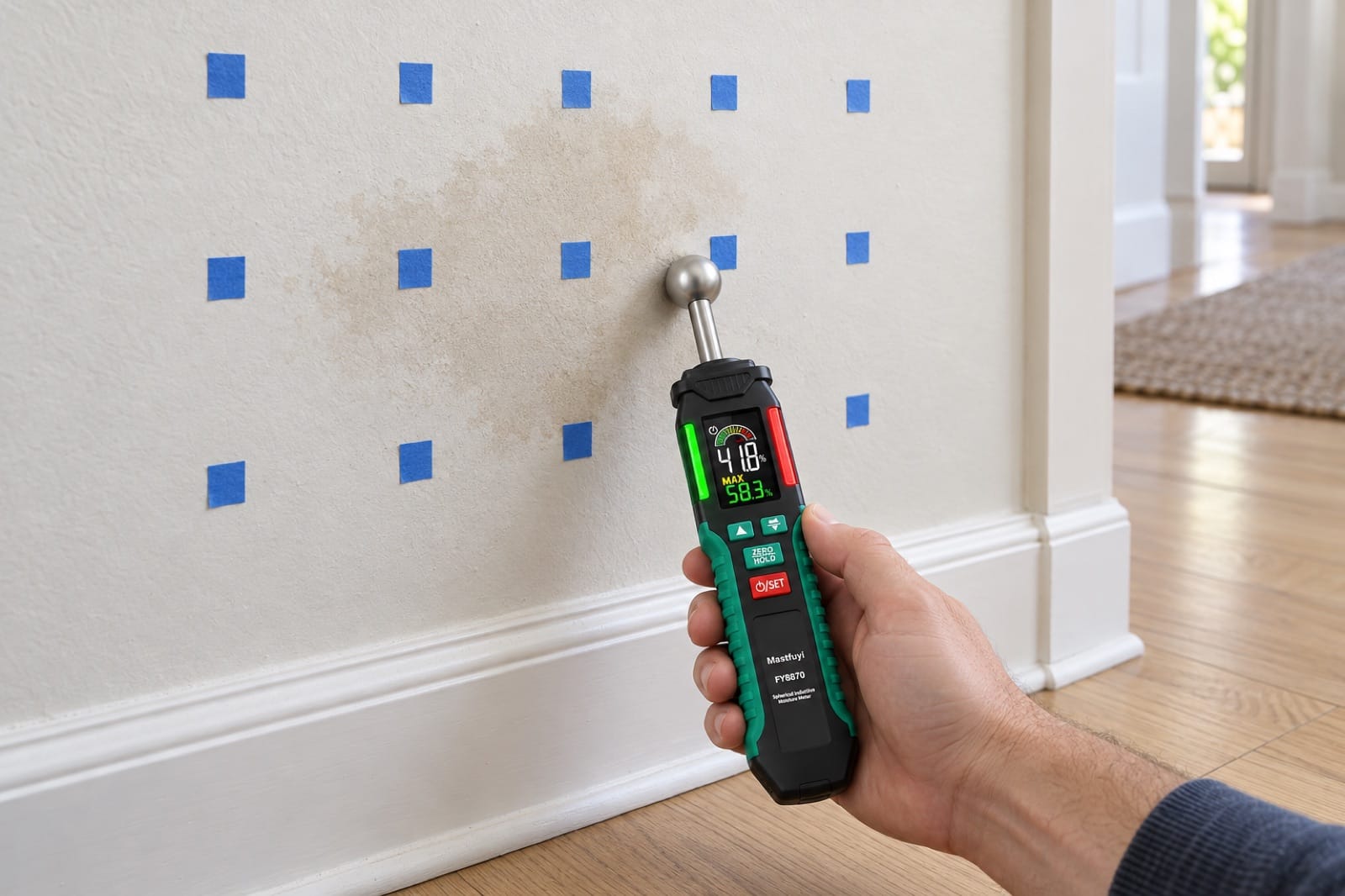
Illustration: take readings every 10–20 cm toward the suspect area; a broad area that climbs toward one spot points to the source.
What should you do with the result?
- The whole area matches your dry reference. The outer layer is probably dry. A cold patch that reads dry may simply be missing insulation, and learning how to read a thermal image helps you tell the two apart.
- A broad area reads high. Look for the source above and uphill of the patch, since water runs along framing before it shows. A stain on a ceiling points to tracing a roof leak from inside; a wall beside a bathroom points to a shower leak and waterproofing check. Otherwise, start with finding a water leak behind a wall.
- The area keeps growing. Water is still arriving. Stop it at the shutoff valve if you can, and call a plumber or roofer if you can't find or reach the source.
- The area is shrinking. It's drying. Hold off on paint or new drywall until the readings match your dry reference.
- The wall smells musty or has visible growth. The meter can't identify it. Our guide to finding the cause of damp and mold covers the next steps.
Whatever the cause, don't wait to dry things out. Cleanup guidance commonly says to dry wet materials within 24 to 48 hours where you can. If water is near outlets or the electrical panel, leave it alone and call an electrician.
What mistakes make moisture readings misleading?
- Reading without a reference. A number on its own says little. Always take the dry spot first.
- Comparing different materials or meters. A reading on drywall and a reading on a stud aren't on equal terms, and neither are numbers from two different meters.
- Testing only the stain. A stain can be old and bone dry, while the water is now traveling somewhere else. Test around it, not just on it.
When do you need a pin meter, or something else?
A pinless meter is the fastest way to find and map moisture, but sometimes you need more:
- An exact moisture content in wood, for example before laying a floor or finishing lumber. A pin meter with species settings is the better tool.
- Moisture deep in concrete. Slab tests for flooring use different methods altogether; ask the flooring maker what they require.
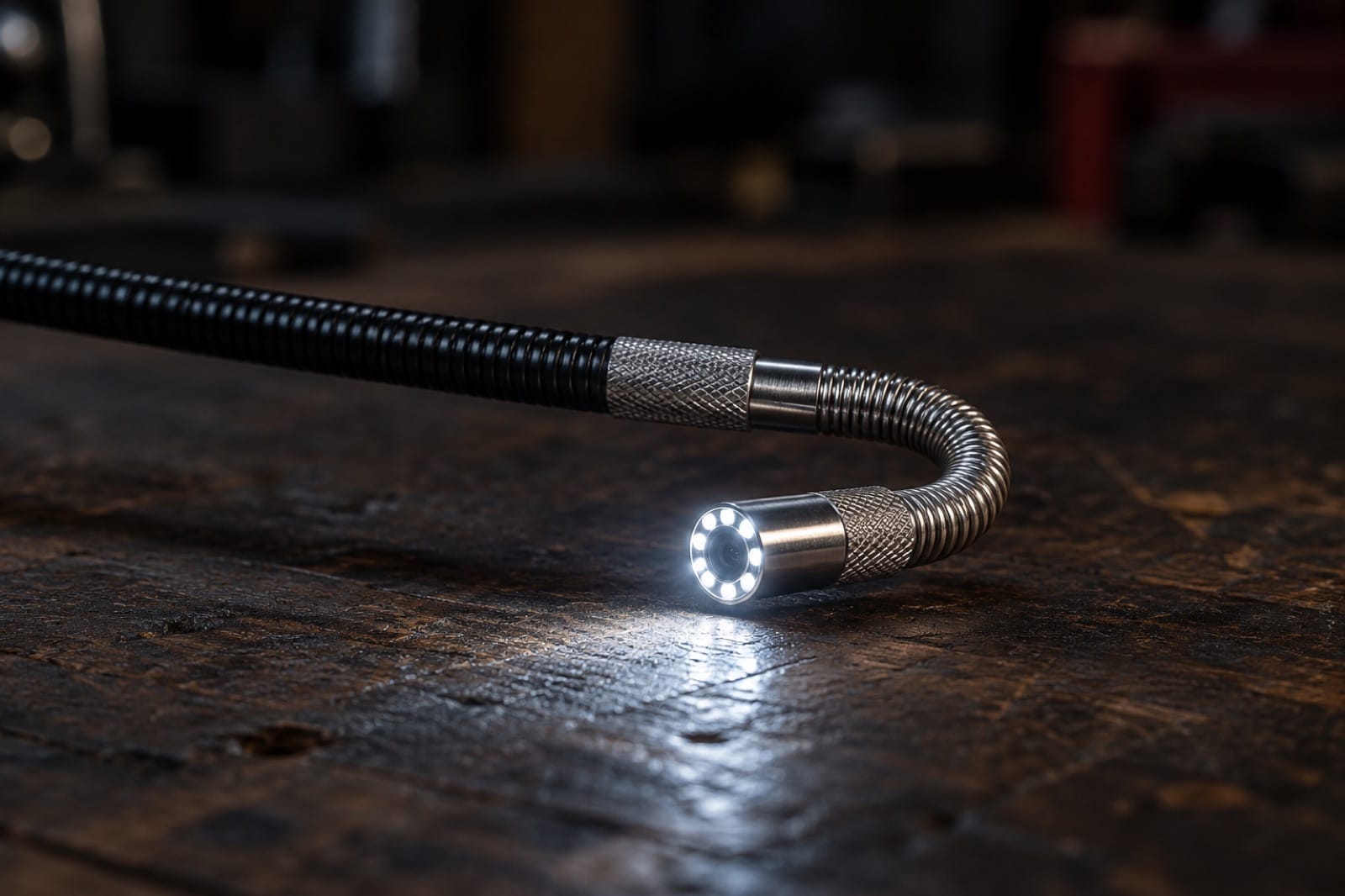
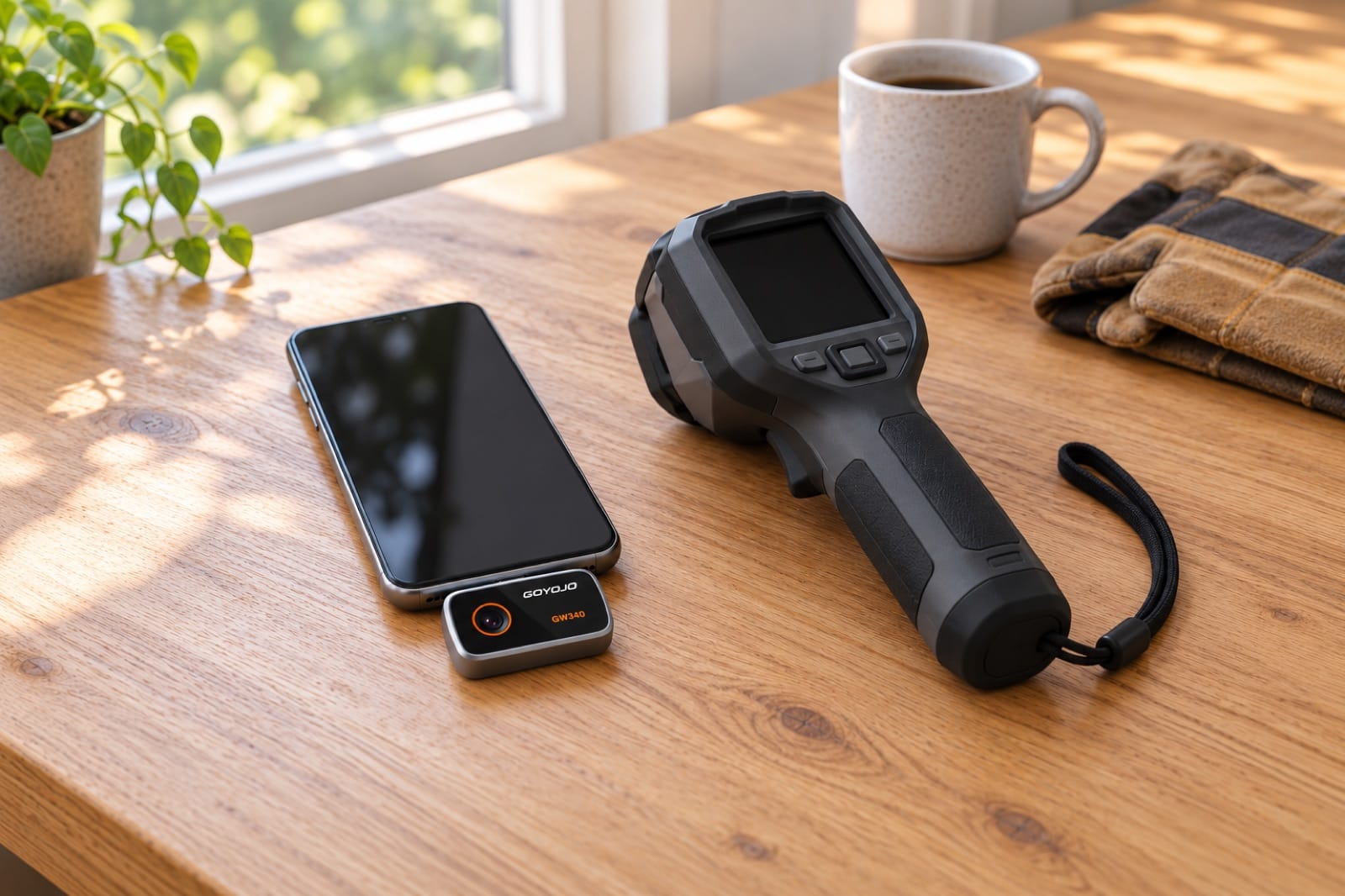
- Behind tile or metal. Readings there are unreliable. Look for the cause another way, such as a thermal camera to find the cold or warm patch, or an inspection camera through a grout line or an access panel. Here's how to choose between a thermal camera, a moisture meter and an inspection camera.
What a pinless meter is great at
- Finding the edge of a leak without making a single hole.
- Showing whether a cold patch on a wall is wet or just cold.
- Checking that a wall, floor or ceiling has dried out after a leak before you repaint or close it up.
- Tracking a damp problem over weeks with the same marks.
If you're choosing one, start with our guide to the pinless moisture meter. Checking a house before you buy or rent? Add a meter to your home inspection checklist.
Frequently asked questions
What moisture level indicates mold?
No moisture reading can tell you that mold is there, because the meter measures water, not growth. What it shows is the conditions mold likes. A common rule of thumb is that wood staying above about 20% moisture content is at risk of mold and decay. Treat any material that stays clearly above your dry reference as a problem, and deal with the water source first.
What are bad moisture readings?
A bad reading is one that sits well above a known-dry spot on the same material, covers a broad area, and doesn't fall over the following days. On a wood scale, over about 20% is the usual warning line. A single spike isn't enough on its own, since it's often a screw or a pipe.
Is a moisture level of 20% in walls bad?
It depends on the scale. On a wood scale, 20% in framing or trim is at the usual warning line and worth investigating. On a meter with its own relative wall scale, 20 may be perfectly normal for that wall. Take a reading on a dry part of the same wall: if it also shows about 20, the number alone isn't a warning sign.
Are pinless moisture meters accurate?
They're reliable for comparing spots on the same material, and less reliable as an absolute measure of water content. Density, metal, surface contact and layers all shift the number, and material modes correct only for typical values. Hold the meter the same way each time, compare with a dry reference, and use a pin meter when you need an exact figure in wood.
Does a high reading always mean a leak?
No. Condensation, a freshly wiped surface, dense material, foil-backed insulation and hidden metal can all raise a reading without any leak, and humid weather can lift it too. Before you hunt for a leak, check for metal, retest beside the spot and repeat a few days later. A reading that stays high over a wider area is the one worth chasing.
The tools in this guide
Prices are on each product page, in your local currency.
Damp is a pinless moisture meter with a spherical sensor. The rounded ball is easy to press flat-on the same way every time, which is half of getting readings you can compare.
- Reads 5–40 mm into the material, depending on what it is.
- Scale of 0.1–99.9 % (±2.5 %), for gypsum and cement walls, wood and paper.
- Color screen, a flashlight and an alarm.
- Runs on 2 × AAA batteries (not included).
- Like every pinless meter, it reads high over metal: nails, pipes or mesh behind the surface. Step aside and compare.
You'll find the current price on the Damp page.
It's also part of the Whole Home Kit: Spark Pro finds the cold or warm patch, Damp confirms it's wet, and Reach 360 looks inside through a small hole, for 10% less than buying them separately.
Find out if it's really wet, without a single hole. Order Damp, or get the Whole Home Kit for the full find-confirm-look routine.